

BELLFARM
Hezhichun Turk's Turban Pumpkin
Sale
Sold out
Regular price
$3.99 USD
Regular price
$6.99 USD
Sale price
$3.99 USD
Unit price
per
Couldn't load pickup availability
-
5-14 Days delivery.
-
Ship out within 24 hours.
Main characteristics of the variety:
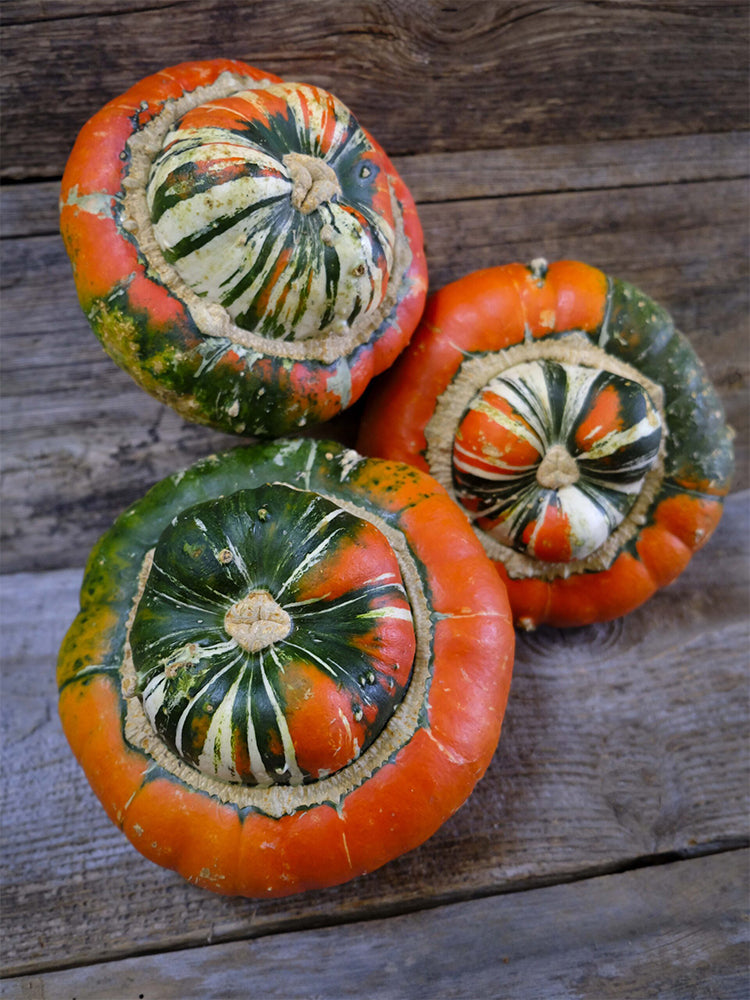
- The Turk's Turban Pumpkin is an annual trailing herb belonging to the Cucurbitaceae family, Cucurbita genus. It is named for its fruit resembling an incense burner. The upper part of the fruit is round and plump, with 2–5 protrusions on the lower part, giving it a unique shape. The upper rind is mostly orange-red or tangerine, while the lower part is grayish-white or greenish-white. The navel is marked with fish-scale-like stripes, forming distinct color layers. Its stem has a round cross-section, and the leaves are entire and covered with soft hairs. The yellow corolla is pubescent, with five veins on the petals. The flowers are relatively large and emit a delicate orchid-like fragrance. The young fruit has tender, sweet flesh with a natural fruity and nutty aroma, and can be prepared and eaten in various ways. Owing to its unique shape and bright colors, it is often carved and painted for decorative melon art, making it valuable for both culinary and ornamental use.
- The Turk's Turban Pumpkin is an annual trailing herb belonging to the Cucurbitaceae family, Cucurbita genus. It is named for its fruit resembling an incense burner. The upper part of the fruit is round and plump, with 2–5 protrusions on the lower part, giving it a unique shape. The upper rind is mostly orange-red or tangerine, while the lower part is grayish-white or greenish-white. The navel is marked with fish-scale-like stripes, forming distinct color layers. Its stem has a round cross-section, and the leaves are entire and covered with soft hairs. The yellow corolla is pubescent, with five veins on the petals. The flowers are relatively large and emit a delicate orchid-like fragrance. The young fruit has tender, sweet flesh with a natural fruity and nutty aroma, and can be prepared and eaten in various ways. Owing to its unique shape and bright colors, it is often carved and painted for decorative melon art, making it valuable for both culinary and ornamental use.