

BELLFARM
Bauhinia purpurea L.
Sale
Sold out
Regular price
$3.99 USD
Regular price
$6.99 USD
Sale price
$3.99 USD
Unit price
per
Couldn't load pickup availability
-
5-14 Days delivery.
-
Ship out within 24 hours.
Morphological characteristics:
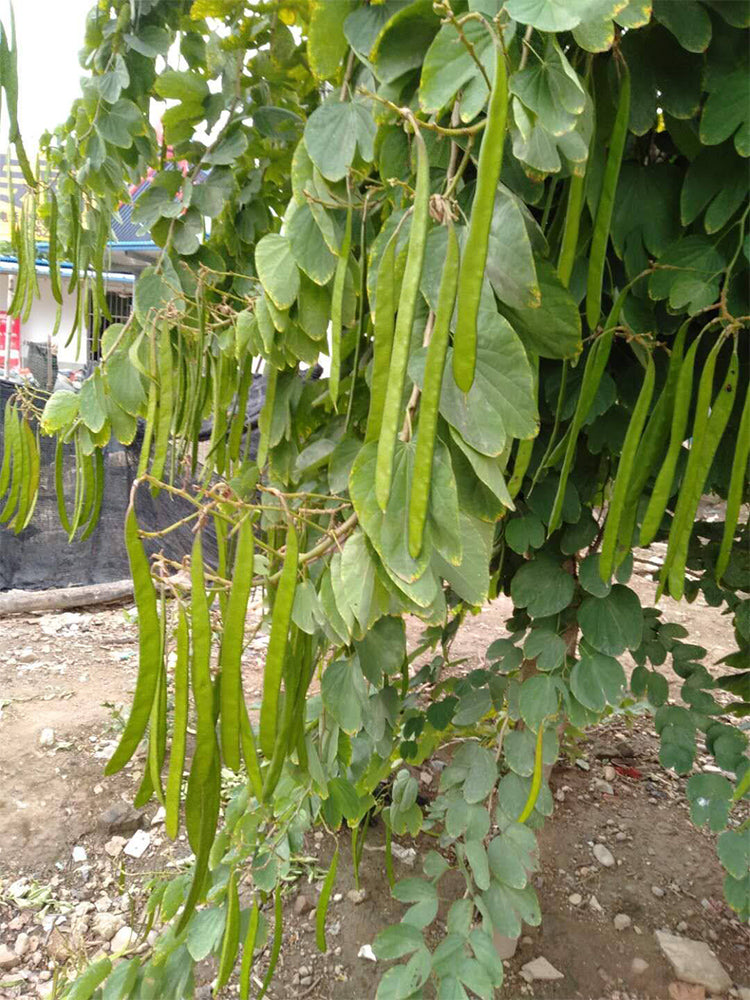
- Bauhinia purpurea L. is an arbor or erect shrub, reaching 7–10 meters in height; the bark is thick and nearly smooth, gray to dark brown. Leaves are thickly papery, shallowly cordate at the base, apically lobed to 1/3–1/2 of the leaf length, with rounded or subacute lobe apices; both surfaces are glabrous, or the abaxial surface is sparsely puberulent. Racemes are lateral or terminal, few-flowered; petals are pinkish-red and oblanceolate. Pods are strap-shaped, flat and slightly falcate; at maturity, the pods dehisce, with woody valves twisting to eject the seeds; seeds are suborbicular and flat, with a dark brown testa. Flowering occurs usually from September to November, and fruiting from February to March. This species is widely cultivated, serving as an ornamental tree for gardens, a street tree and a greening tree; its bark, flowers and roots are used medicinally, but the bark is highly toxic and strictly prohibited for oral administration.
- Bauhinia purpurea L. is an arbor or erect shrub, reaching 7–10 meters in height; the bark is thick and nearly smooth, gray to dark brown. Leaves are thickly papery, shallowly cordate at the base, apically lobed to 1/3–1/2 of the leaf length, with rounded or subacute lobe apices; both surfaces are glabrous, or the abaxial surface is sparsely puberulent. Racemes are lateral or terminal, few-flowered; petals are pinkish-red and oblanceolate. Pods are strap-shaped, flat and slightly falcate; at maturity, the pods dehisce, with woody valves twisting to eject the seeds; seeds are suborbicular and flat, with a dark brown testa. Flowering occurs usually from September to November, and fruiting from February to March. This species is widely cultivated, serving as an ornamental tree for gardens, a street tree and a greening tree; its bark, flowers and roots are used medicinally, but the bark is highly toxic and strictly prohibited for oral administration.